
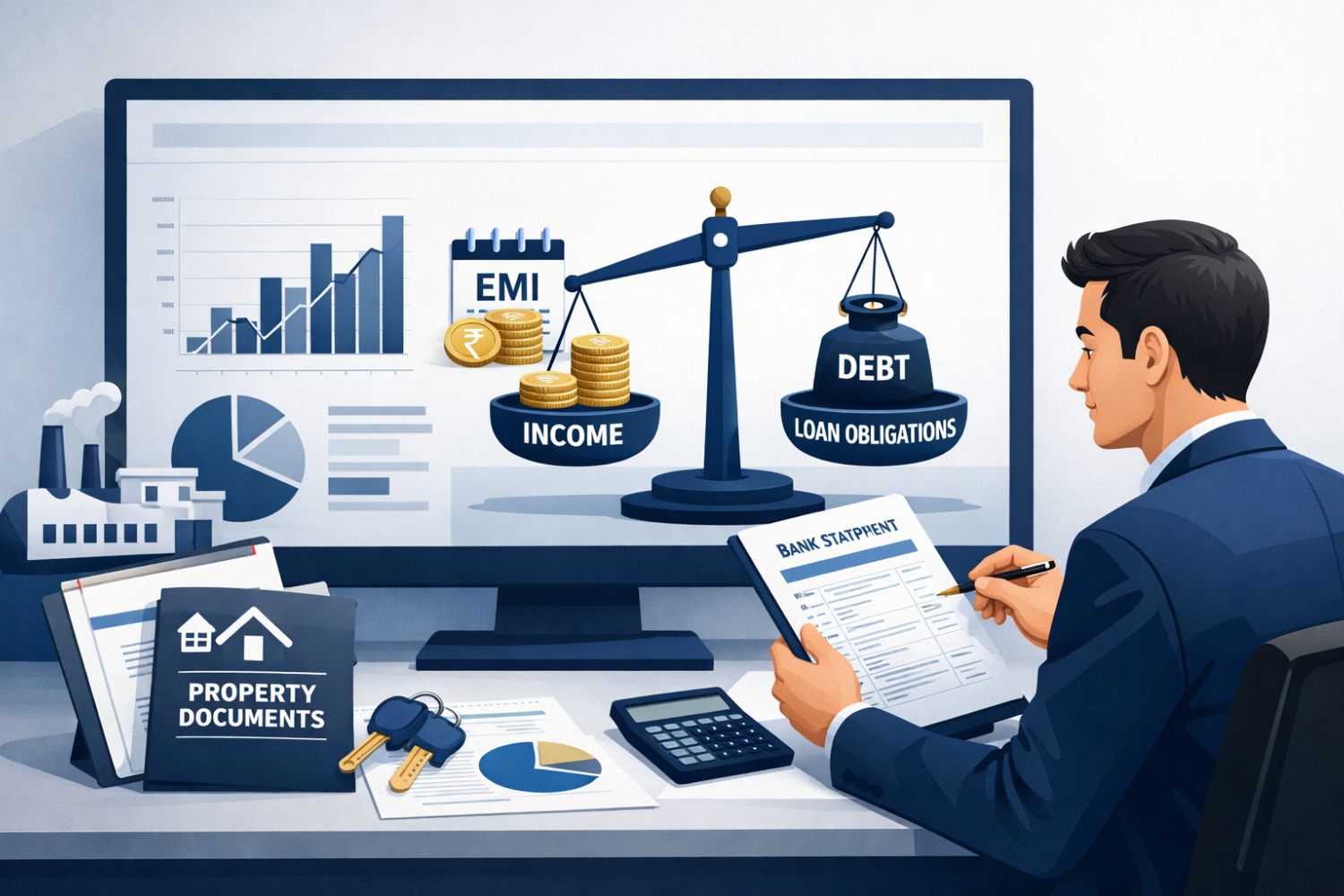
Secured Business Loan DSCR Made Simple
A 5-Step Check for DSAs
DSCR doesn’t need to be complicated. If you can estimate cash inflow versus debt outflow, you can filter business loan cases that will close versus cases that will stall in underwriting.
For DSAs sourcing सुरक्षित बिजनेस लोन, doing a quick DSCR check before submitting the file saves time, improves approval chances, and helps present stronger borrower profiles to lenders.
DSCR Explained in Simple Language
DSCR (Debt Service Coverage Ratio) measures whether a business generates enough income to repay its loan obligations.
Formula: DSCR = Net Business Income ÷ Total EMI Obligations
It answers one simple underwriting question: Can the business comfortably repay the loan from its cash flow?
If the borrower has ₹30 lakh available monthly cash flow and total EMI obligation is ₹20 lakh, the DSCR is: ₹30 lakh ÷ ₹20 lakh = 1.5x
This means the borrower earns 1.5 times the amount required to pay the EMI.
Even if a borrower has good collateral, lenders still check whether the business income supports the loan EMI. Strong cash flow plus acceptable collateral significantly improves the chances of business loan approval.
Quick 5- Step Check for DSCR
Before submitting a secured business loan case, DSAs can run a quick DSCR check using two basic inputs.
Step 1: Check monthly business inflow
First, understand the borrower’s regular monthly income from business operations for at least past 12 months
Question to Ask
“What is your average monthly business turnover, and how much of it is regular?”
Do not rely only on verbal turnover claims. Try to check whether the bank statement, GST returns, and financials broadly support the numbers.
Step 2: Estimate Monthly Business Surplus
Turnover is not the same as repayment capacity. A business may have ₹1 crore monthly sales but very low margins. DSCR should be checked on surplus cash flow, not just sales.
Question to Ask
“After paying business expenses, how much monthly surplus does the business usually generate?”
Estimate the monthly surplus after major operating cash expenses such as: Raw material purchase, Salaries, Rent & Utilities, Transport and Logistics, administrative expenses and statutory obligations.
Step 3: Identify existing EMI obligations
Next, check all existing loan obligations of the business
Question to Ask
“How much EMI are you already paying every month across all loans?”
Verify the same through Credit information reports (e.g. CIBIL), bank statements and loan statements.
Step 4: Estimate new loan EMI
Now estimate the EMI of the proposed loan.
For example, if the borrower wants a ₹2 crore secured business loan, calculate the approximate monthly EMI based on expected tenure and interest rate. Then add this estimated EMI to existing EMIs.
Formula: Total EMI Obligation = Existing EMIs + Proposed Loan EMI
Step 5: Compare income vs obligations
Now, estimate the additional revenue that the borrower can generate with the new proposed loan. Add it to the monthly income calculation based on existing margins.
Compare the final monthly income with monthly obligations to check whether the proposed loan is viable for your client.
This quick filter helps DSAs avoid submitting files where cash flow is too tight despite strong collateral.
What ‘Comfortable’ Looks Like (Practical Framing)
Lenders typically look for DSCR above 1, meaning the business earns more than its debt payments.
A practical way to think about it:
- DSCR > 1 → Sufficient income to cover debt payments (favourable for loans).
- DSCR < 1 → Insufficient income; higher risk of default.
- DSCR = 1 → Just enough income to cover debt, but no extra cushion.
When a business has stable bank inflows, manageable EMIs, and clear collateral property, they become much stronger for a secured MSME loan approval.
Common Mistakes DSAs Make (And How to Avoid Them)
Many business loan files get delayed because the initial DSCR estimate was unrealistic. Common mistakes include
- Looking only at turnover
High sales do not always mean high repayment capacity. Always check margins and surplus. - Counting One-Time Income
Avoid treating one-time receipts, asset sales, or temporary credits as regular cash flow. - Ignoring Seasonality
Some MSMEs have seasonal business. Average income should be checked carefully. - Assuming collateral guarantees approval
Even with strong property collateral, lenders still evaluate business cash flow stability. - Submitting incomplete borrower information
Clear financial snapshots help credit teams evaluate the case faster.
Borrower Snapshot Template (Quick Example)
Before submitting a secured business loan file, DSAs can prepare a simple borrower snapshot.
Business Name: XYZ Ltd
Industry: Manufacturing
Average Monthly Income: ₹12,00,000
Existing EMI Obligations: ₹3,50,000
Estimated New Loan EMI: ₹2,00,000
Total EMI Outflow: ₹5,50,000
Collateral Property: Industrial unit / commercial property
This quick snapshot helps lenders understand business cash flow, loan obligations, and collateral strength at a glance.
Conclusion
For DSAs, a simple DSCR pre-check can make the difference between a file that moves smoothly through underwriting and one that stalls midway. By quickly assessing business cash flow against total debt obligations, you can submit stronger, well-filtered loan cases. This not only increases approval probability but also builds credibility with lenders over time.
Ready to Grow as a DSA?
Submit Your Application in Minutes
About Red Fort Capital
Red Fort Capital is dedicated to empowering Indian MSMEs (Micro, Small, and Medium Enterprises) on their path to business growth through customized business loans. We understand that securing a business loan in India can pose significant challenges, particularly when factors like a less-than-ideal credit score, a relatively short business history, unclear financial records, or variable cash flow come into play.
As a respected Non-Banking Financial Company (NBFC), we take pride in offering a diverse range of secured business loans, spanning from 1 to 10 Crores. What sets us apart is our remarkable ability to disburse funds fast, in just 7 days. Our financial solutions are meticulously designed to cater to a spectrum of needs, including working capital requirements, equipment and machinery purchases, invoice/bill discounting, and last-mile financing, among others.
